
|
What this covers
|
A desk purchase goes well or badly for reasons that are mostly settled before anybody clicks buy. The listing is accurate, the dimensions are published, the reviews are positive, and the thing still turns out to be wrong for the room.
That happens because the specifications a listing leads with answer questions nobody was going to get wrong, and the questions that actually decide the outcome are answered somewhere further down, or not at all. Here are the five that surface after the box arrives.
The Weight Is Discovered at the Door
Shipping weight differs from assembled weight. Both numbers appear somewhere, rarely together, and the shipping figure includes packaging that can add a meaningful fraction on a large item.
Height-adjustable desks are heavier than fixed ones for a structural reason. An electric lift column adds weight to a desk frame. A motor, a gearbox, a telescoping column and the steel to keep it rigid all sit inside the legs. The stability that makes a raised desk feel solid is largely mass, so the heaviness is doing a job rather than being an oversight.
The consequence is practical and immediate. A single person may not be able to move the carton from where the courier leaves it, which for a freight delivery can mean the curb. That is a problem to solve before delivery day, not during it.
The Box Has to Fit Through the Door
A boxed desk must pass through the doorway of the room it will be used in. Desktop dimensions are published. Carton dimensions frequently are not, and a carton is larger than its contents in every direction.
This matters most in older buildings and in apartments with a turn in the hallway or a stairwell landing. A 52-inch desktop is fine. The carton around it, carried at an angle up a stair with a half-landing, sometimes is not.
The fix is unglamorous: find the carton dimensions before ordering, and measure the narrowest point on the route, which is usually a turn rather than a doorway.
Assembly Is Discovered on the Floor
Listings describe assembly as a time cost. It is two costs.
Assembly time is paid once and torque accuracy is paid continuously. The hour on the floor with an Allen key is the visible part. The invisible part is that every fastener tightened by hand is a variable, and under-tightened bolts are the origin of most wobbles that appear weeks after a desk was declared fine.
A height-adjustable desk makes this worse than a fixed one, because the frame is carrying load through a moving column rather than sitting still. Anything loose gets worked on twice a day.
A desk delivered assembled removes the largest single-day time cost and removes that variable with it. It is worth checking whether a product ships assembled at all, because the phrase “easy assembly” and the phrase “no assembly” are separated by about an hour and a durability question.
The Bottom of the Range Goes Unchecked
A height range has a minimum as well as a maximum. Buyers check the top of the range against their standing height, which is the number the marketing leads with, and rarely check the bottom against anything.
The minimum decides three things that only become apparent in use:
- Whether a shorter person can sit at it comfortably with their feet flat
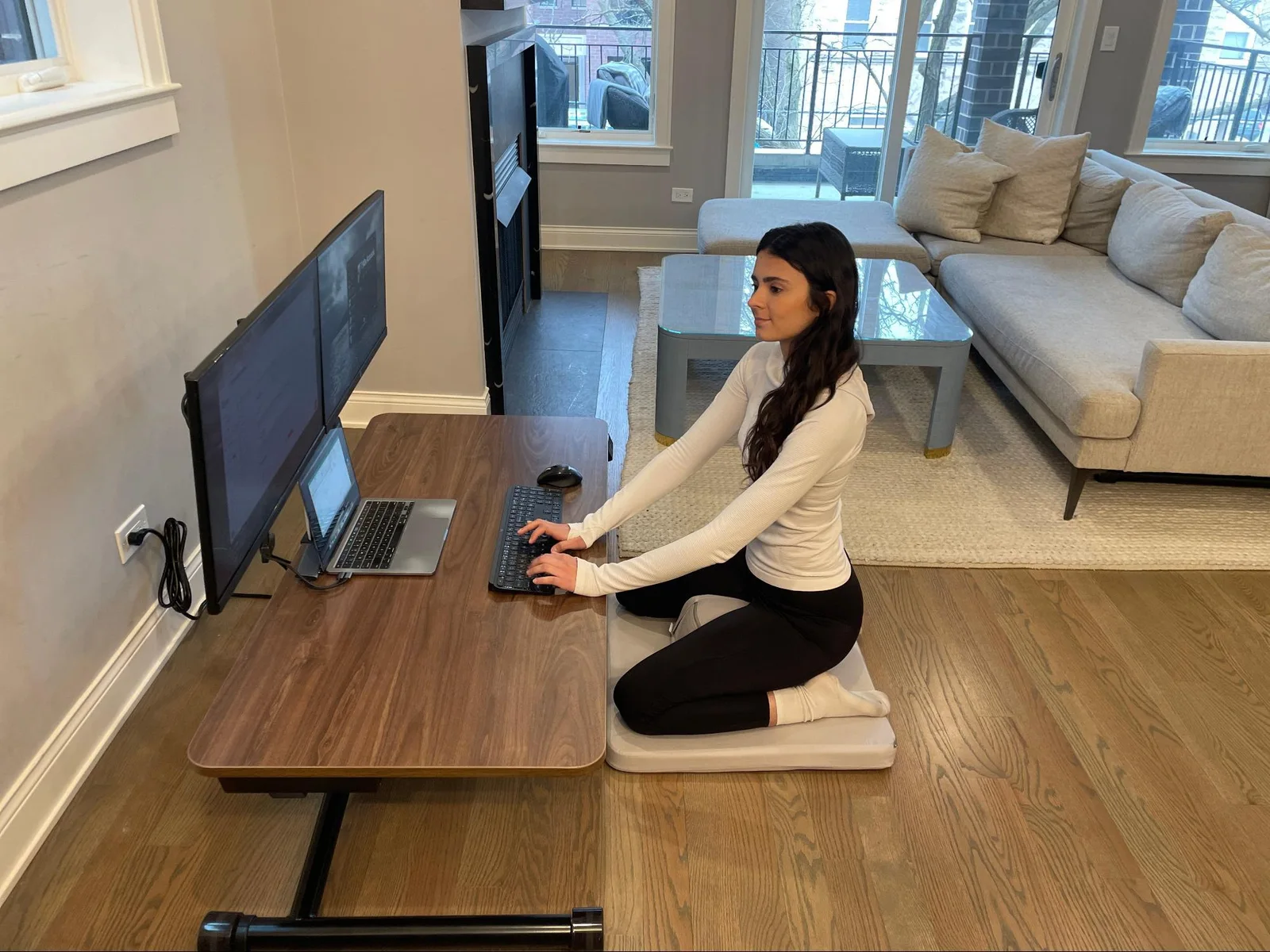
- Whether the desk works with a low chair, a floor cushion or a sofa
- How tall the desk is when it is fully lowered and supposedly out of the way
That last point is where the category divides. A desk whose minimum is 28 inches lowers to a normal desk. A desk whose minimum is closer to the floor lowers to something that can be worked at while seated on the ground and, if the frame folds, stored somewhere a 28-inch object cannot go.
The Lillipad desk publishes both ends, six inches to forty-eight inches, which is a full travel description rather than a standing height with an implied floor. Anybody shortlisting foldable desks with an electric lift will find that both-ends framing is the exception rather than the norm, and the omission is usually at the bottom.
Depth Decides More Than Width
Desk depth determines monitor viewing distance. Width gets all the attention because it is the number that sounds like capacity, and depth is the one that decides whether the setup is comfortable.
A screen needs to sit roughly an arm’s length from the eye. On a shallow desk it cannot, so it ends up closer, and the result is eye strain that shows up within the first week and gets blamed on the monitor.
A monitor arm changes this, because it moves the screen back off the surface and frees the depth the base was occupying. On a shallow desk an arm is not an accessory, it is the fix.
|
The number people compare |
The number that decides the outcome |
|
Desktop width |
Desktop depth |
|
Maximum height |
Minimum height |
|
Assembled weight |
Carton dimensions |
|
Load capacity |
Whether it is static or operational |
|
Warranty length |
Which components the warranty names |
What a Return Policy Costs to Use
A return window is a number on a page. Using one has a price that is not on the page.
Freight return shipping costs more than parcel return shipping, and a large desk ships freight. A restocking fee reduces the value of a stated return window by a percentage that is sometimes substantial on a high-ticket item. Between the two, a generous-sounding policy can cost a meaningful share of the purchase to exercise.
The questions worth asking before ordering are narrow:
- Who pays return shipping, the buyer or the seller
- Is there a restocking fee, and what percentage
- Does the product need to be in its original packaging
- Does the window start at order or at delivery
Point four is the one that quietly matters. A 30-day window starting at order, on an item with a two-week lead time, is a two-week window.
There is a related detail on the warranty side. Warranty length is the number quoted and the component list is the number that counts. A five-year warranty that names the motor, the frame, the electronics, the sheet metal and the wheels is describing the parts that are expensive to replace and likely to fail. A five-year warranty on “the product” leaves the coverage to be decided later, by the party writing the check.
On a height-adjustable desk the motor and the control electronics are the two components where failure is both plausible and costly, because neither is user-serviceable and neither has a generic replacement. Any warranty discussion that does not name them has skipped the expensive half.
A return window measured in days should span a full working month. A desk cannot be evaluated in a weekend. The problems that cause regret are the ones that emerge in week three, when the novelty is gone and the setup routine has either become automatic or become an irritation. A 60-day policy, of the kind Lillipad publishes, covers that period twice and is long enough to find out the truth.
The Measurements to Take Before Ordering
None of this requires expertise. It requires ten minutes with a tape measure and a willingness to write five numbers down.
|
Measure |
Why |
|
The narrowest point on the delivery route |
The carton has to get there |
|
Clearance behind the working position |
A chair needs to withdraw |
|
Clearance under the bed, sofa or closet rail |
Only matters if the desk is meant to store |
|
Distance to the nearest power outlet |
An electric desk needs one permanently |
|
Eye to screen distance you find comfortable now |
Sets the minimum depth |
The last one is the least obvious and the most useful. Measure the distance you already sit from a screen you are comfortable with. That number, plus the depth the monitor base occupies, is the minimum depth the new desk has to have.
The Pattern Underneath All Five
Every one of these is a mismatch between a product specification and a room specification, and only one side of that pair is published.
Manufacturers describe the desk. Nobody describes the room, the doorway, the stairwell, the outlet position or the height of the person who will sit at it. The listing cannot make that mismatch visible, which means the buyer has to, and the whole job takes about ten minutes.
It is the ten minutes that separates a desk that was right on paper from one that is right in the room.
None of the five problems above is a manufacturing defect, which is why none of them is caught by a review. Reviews describe the product, and the product is usually fine. What fails is the fit between a well-made object and a particular hallway, a particular outlet position and a particular person’s height, and that fit is the buyer’s responsibility because nobody else has the measurements.