
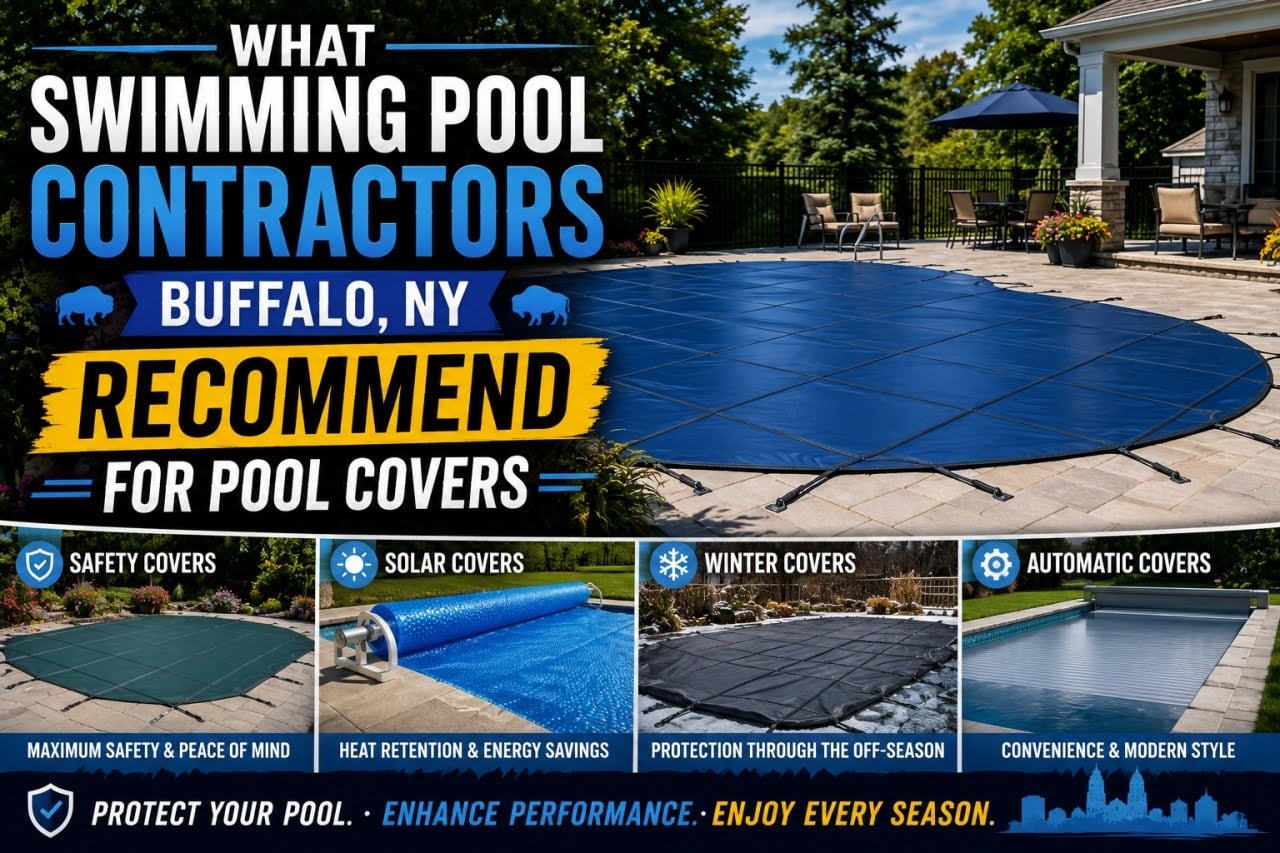
Owning a swimming pool in Buffalo means enjoying beautiful summer days while also preparing for a long and demanding off-season. Once temperatures begin dropping, the right pool cover becomes an important part of protecting the pool from leaves, debris, precipitation, and winter conditions.
The challenge is that pool covers aren’t all the same. Mesh safety covers, solid safety covers, automatic covers, and basic winter covers each have different advantages. Experienced swimming pool contractors buffalo ny can help homeowners choose a cover based on their pool design, surrounding landscape, safety priorities, maintenance expectations, and how they plan to use the pool.
For Western New York homeowners, understanding these differences can make fall closing and spring opening considerably easier.
Why Pool Covers Matter in Buffalo
Buffalo’s climate makes seasonal pool protection especially important.
During the months when a pool isn’t being used, it can be exposed to:
- Snow
- Rain
- Leaves
- Branches
- Dirt
- Freezing conditions
- Other debris
A properly selected and installed cover helps protect the pool throughout this extended period.
Local Western New York installers offer both mesh and solid pool safety covers specifically for seasonal pool protection.
Safety Cover vs. Basic Winter Cover
One of the first distinctions homeowners should understand is the difference between a safety cover and a cover intended primarily to keep debris out.
Not every pool cover is designed or certified to function as a safety barrier.
If safety is an important objective, homeowners should specifically discuss a compliant safety cover with their pool professional rather than assuming any winter cover provides equivalent protection.
The Pool & Hot Tub Alliance notes that solid safety covers should meet the ASTM F1346-91 safety-cover standard and must have a means of preventing water from accumulating on top.
Mesh Safety Covers Are Popular for Buffalo Winters
Mesh safety covers are a common choice for seasonal pools.
They’re secured over the pool using an anchored system and allow rainwater and melting snow to drain through the material.
Advantages can include:
- Water drainage
- Relatively manageable weight
- Strong debris protection
- Easier handling than many solid covers
- Long-term durability
Buffalo-area suppliers specifically highlight water drainage as a major advantage of mesh inground safety covers because it prevents water from building up on top. For homeowners who don’t want to regularly pump accumulated precipitation from the cover, this can be particularly appealing.
Consider Higher-Density Mesh
Not all mesh covers use identical materials.
Higher-density mesh can provide a compromise between conventional mesh and solid-cover performance.
A tighter weave may allow precipitation to drain while blocking more sunlight and finer debris.
This can be attractive for homeowners who want the convenience of drainage while reducing the amount of material entering the pool during winter.
Western New York installers offer both standard and more tightly woven mesh options.
Solid Safety Covers Block More Sunlight
Solid covers provide another approach.
Instead of allowing water to filter through the entire cover surface, solid materials create a stronger barrier against sunlight and fine debris.
Potential advantages include:
- Blocking sunlight
- Keeping fine debris out
- Potentially cleaner water at opening
- Creating a more complete surface barrier
Blocking sunlight can be particularly helpful for limiting the conditions that encourage algae growth during the off-season.
Solid Covers Need Water Management
A major consideration with a solid cover is what happens to precipitation.
Rain and melting snow can’t simply drain through an impermeable surface.
Depending on the cover design, water may be managed through:
- Drain panels
- Automatic cover pumps
- Other manufacturer-approved drainage systems
This isn’t a minor consideration.
The Pool & Hot Tub Alliance warns that accumulated rainwater on solid safety covers can itself create a drowning hazard, which is why appropriate water-management provisions are important.
Mesh vs. Solid: Which Is Better?
There isn’t one correct answer for every Buffalo pool.
A mesh safety cover may be preferable if you prioritize:
- Drainage
- Lower cover weight
- Easier seasonal handling
- Less surface-water management
A solid safety cover may be preferable if you prioritize:
- Maximum sunlight blockage
- Keeping finer material out
- Potentially cleaner spring water
The right choice depends on the property and maintenance preferences.
Consider the Trees Around Your Pool
Your landscaping can influence which cover makes sense.
A pool surrounded by mature trees may experience considerable leaf and organic debris during autumn.
In this situation, homeowners may prioritize a cover that minimizes the amount of fine debris entering the water.
Properties with relatively little surrounding vegetation may have different priorities.
When swimming pool contractors buffalo ny evaluate cover options, the pool’s surroundings can be just as important as its dimensions.
Custom-Fitted Covers Matter
Pools come in many shapes.
Your pool might include:
- Custom steps
- Curved sections
- Raised walls
- Water features
- Spas
- Irregular decking
- Other architectural elements
A safety cover needs to account for these features.
Professional measurement helps ensure that the cover is designed around the actual pool rather than relying on an approximate generic size.
Buffalo-area installers advertise measurement and installation for new and replacement custom safety covers.
Anchoring Is an Important Part of the System
Safety covers typically rely on anchors installed around the pool deck.
The cover is tensioned using straps and springs connected to those anchors.
A professionally planned system should account for:
- Pool dimensions
- Cover geometry
- Deck material
- Obstructions
- Anchor locations
- Proper tension
When the cover is removed for swimming season, many systems use anchors designed to sit flush with the surrounding deck.
What About Automatic Pool Covers?
Automatic pool covers provide a different type of convenience.
Rather than manually installing a seasonal cover, an automatic system can open and close using a motorized mechanism.
Depending on the specific system, advantages may include:
- Convenient daily operation
- Reduced debris
- Reduced evaporation
- Heat retention
- An additional safety measure when the system is designed and used accordingly
Automatic covers are particularly appealing to homeowners who want to cover their pool frequently throughout the swimming season.
Plan Automatic Covers During Pool Design
If you’re building a new pool and interested in an automatic cover, discuss it with your builder early.
Automatic systems can require:
- Cover tracks
- Motor housing
- Electrical infrastructure
- Deck integration
- Specific geometric considerations
Planning these components during initial pool design can create a cleaner installation than trying to incorporate them later.
Ask About Winter Use of Automatic Covers
Homeowners should specifically ask the manufacturer and installer whether an automatic cover is intended to serve as the pool’s winter cover under Buffalo conditions.
Recommendations can vary according to system design.
Some pool professionals recommend using a separate safety cover for winter because heavy snow accumulation can place substantial loads on automatic-cover components.
Follow the requirements of the particular cover manufacturer and your pool professional rather than assuming an automatic cover can handle every seasonal condition.
Solar Covers Serve a Different Purpose
Solar covers shouldn’t be confused with winter safety covers.
They’re generally designed for swimming-season benefits such as:
- Reducing evaporation
- Helping retain heat
- Limiting some debris
They aren’t automatically substitutes for compliant safety or winterization systems.
If child or pet safety is the primary concern, ask specifically whether the product you’re considering is certified for that purpose.
Think About Children and Pets
Safety is one of the most important considerations when selecting a pool cover.
Homeowners with children or pets should discuss safety barriers with a qualified pool professional and understand exactly what the chosen product is designed to do.
Don’t assume that because a cover stretches across the water it can safely support someone who steps onto it.
Look specifically for products designed and tested as safety covers.
Pool Covers Don’t Replace Supervision
Even a properly installed safety cover shouldn’t create a false sense of security.
Pool owners should continue following appropriate safety practices, which can include:
- Active supervision
- Barriers
- Gates
- Secure access
- Appropriate pool rules
- Maintaining safety equipment
A cover is one component of a broader pool-safety strategy.
Think About Spring Opening
Your fall cover choice can affect your spring workload.
When selecting a cover, consider how much time you’re willing to spend dealing with:
- Leaves
- Fine debris
- Standing water
- Algae
- Cover cleaning
- Cover removal
A cover that costs more initially may be worthwhile if it makes seasonal maintenance significantly easier for your household.
Inspect Your Cover Every Year
Pool covers experience substantial environmental exposure.
Before closing your pool, inspect the cover and related hardware for:
- Tears
- Worn straps
- Damaged stitching
- Broken springs
- Loose anchors
- Excessive wear
- Other visible damage
If you’re unsure whether the cover remains safe to use, have it evaluated professionally.
Don’t Wait Until the First Freeze
Pool-cover planning shouldn’t begin when winter weather has already arrived.
Custom covers may require:
- Pool measurement
- Cover selection
- Manufacturing or ordering
- Delivery
- Installation
Starting early provides more time to address replacement needs before the pool is scheduled to close.
Store the Cover Properly During Summer
A quality safety cover represents an investment, so storage matters.
Once removed, the cover should generally be cleaned, dried as appropriate, and stored according to manufacturer recommendations.
Improper storage can expose it to:
- Moisture
- Mold
- Rodents
- Sharp objects
- Unnecessary material deterioration
Follow the specific care instructions provided with your cover.
Consider the Total Cost of Ownership
The cheapest cover isn’t necessarily the least expensive option over the life of the pool.
When comparing choices, consider:
- Initial purchase price
- Installation
- Expected service life
- Maintenance
- Replacement frequency
- Water management
- Spring cleanup
- Convenience
A durable, properly fitted safety cover may provide better long-term value than repeatedly replacing a lower-quality alternative.
Professional Installation Can Be Worth It
A safety cover isn’t simply a piece of material stretched over the pool.
Proper installation requires accurate measurements and appropriate positioning of anchors, straps, springs, and other components.
Professional installation can be especially valuable for:
- Freeform pools
- Pools with raised features
- Unusual decking
- Integrated spas
- Custom steps
- Replacement covers
Buffalo-area pool service companies specifically offer professional safety-cover installation and replacement throughout Western New York.
Match the Cover to the Pool
Ultimately, swimming pool contractors buffalo ny aren’t likely to recommend exactly the same cover for every homeowner.
The decision should consider:
- Pool shape
- Pool size
- Deck configuration
- Landscaping
- Winter conditions
- Safety priorities
- Maintenance expectations
- Budget
- Desired convenience
A custom recommendation is much more useful than simply choosing whichever cover has the lowest price.
FAQs
What type of pool cover is best for Buffalo winters?
Mesh and solid safety covers can both be appropriate. Mesh allows precipitation to drain through, while solid covers provide greater sunlight and fine-debris blockage. The best choice depends on the pool, property, and homeowner’s maintenance priorities.
Are mesh pool covers good for snow?
Mesh safety covers allow melting snow and precipitation to drain rather than accumulating as standing water. The specific cover should still be properly sized, installed, and used according to manufacturer requirements.
Do solid pool covers require pumps?
Some solid covers require pumps to manage surface water, while other designs incorporate drainage panels. Follow the manufacturer’s instructions for the specific system.
Is an automatic pool cover worth considering?
It can be particularly useful for homeowners who value convenience, evaporation reduction, heat retention, debris control, and frequent covering during swimming season. Installation requirements and winter use should be discussed with the builder and manufacturer.
What do swimming pool contractors buffalo ny consider when recommending a cover?
Experienced swimming pool contractors buffalo ny can evaluate the pool’s dimensions, shape, surrounding deck, landscaping, safety requirements, seasonal maintenance expectations, and Buffalo’s winter conditions before recommending an appropriate cover system.
Final Thoughts
The right pool cover does more than keep leaves out of the water. For Buffalo homeowners, it becomes an important part of protecting the pool throughout months of snow, rain, freezing temperatures, and seasonal debris.
Mesh safety covers can provide convenient drainage and manageable handling, while solid safety covers can offer greater sunlight and fine-debris protection. Automatic systems provide another level of convenience during the swimming season, although their suitability for winter conditions should always be confirmed for the specific product.
Working with experienced swimming pool contractors buffalo ny can help you compare these options based on your actual pool rather than choosing a one-size-fits-all solution. With a properly selected, professionally fitted cover and a thorough winterization plan, you can protect your investment through Western New York’s off-season and make the return to swimming easier when warm weather arrives.