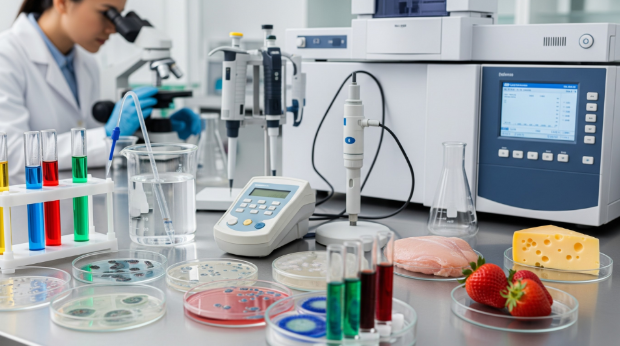
Every meal’s story begins long before it reaches the plate. It starts in the quiet hum of a laboratory – where scientists and instruments work to ensure that what people eat is clean, safe, and free from invisible threats. Food safety is the foundation of public trust.
This article explores how Qalitex safeguards that trust through microbiological and chemical testing services designed to protect consumers and strengthen global food quality.
Why Microbiological and Chemical Testing Matter in Food Safety
Food can carry risks we can’t see. Bacteria, toxins, and chemical residues can find their way into products at any stage – from harvesting to packaging. Microbiological and chemical testing exist to detect those threats early and prevent them from ever reaching consumers.
Understanding microbiological testing
Microbiological testing identifies harmful microorganisms that could cause spoilage, illness, or foodborne outbreaks. In Qalitex laboratories, this process goes beyond basic detection. It helps manufacturers understand how and where contamination occurs, guiding safer production systems.
Common microbial threats include:
- Pathogenic bacteria such as Salmonella, Listeria monocytogenes, and E. coli O157:H7.
- Spoilage organisms that affect shelf life, like yeast and mold.
- Indicator organisms (e.g., coliforms) that reveal potential hygiene lapses during processing.
Microbiological testing isn’t only about confirming contamination. It’s about identifying the root cause – be it poor storage, sanitation issues, or environmental exposure – so corrective measures can be implemented before distribution.
Understanding chemical testing
Chemical testing examines the composition of food for contaminants that might not cause immediate illness but pose long-term risks. These tests determine whether levels of certain elements or compounds comply with safety limits set by regulators such as the FDA, Health Canada, or the European Food Safety Authority (EFSA).
Chemical analysis can identify:
- Heavy metals (lead, mercury, arsenic, cadmium) that accumulate in the body.
- Pesticide residues that exceed approved limits.
- Mycotoxins produced by molds in grains and nuts.
- Unapproved additives or preservatives that may appear in complex ingredient chains.
By testing for both natural and synthetic contaminants, laboratories like Qalitex ensure that food products meet global safety standards before entering the market.
Inside Qalitex’s Food Testing Process
Behind every Qalitex report is a systematic process built on accuracy, documentation, and precision. From sample reception to data validation, every step is designed to minimize error and maintain the integrity of the result.
How samples are prepared and handled
Sample preparation is the foundation of reliable results. Even the best analytical instruments can produce misleading data if a sample is mishandled. At Qalitex:
- Each sample is labeled and documented upon arrival.
- Chain-of-custody protocols ensure traceability.
- Proper environmental conditions are maintained to prevent degradation.
- Controls and blanks are included to verify accuracy.
This careful approach ensures that the test result reflects the true condition of the food, not the influence of external contamination.
How to do microbial testing
Microbial analysis begins with selective enrichment, where samples are incubated to allow potential microorganisms to grow. Scientists then identify and quantify the colonies using validated techniques such as:
- Culture methods following ISO and AOAC standards.
- PCR-based detection for rapid pathogen identification.
- ATP bioluminescence assays for hygiene verification.
Each result is verified through control organisms and documented for consistency. Qalitex maintains strict adherence to internationally recognized protocols to ensure findings are both defensible and reproducible.
How to do chemical testing
Chemical testing demands high precision and technical expertise. Advanced instruments such as Gas Chromatography–Mass Spectrometry (GC-MS), Liquid Chromatography–Mass Spectrometry (LC-MS), and Inductively Coupled Plasma Mass Spectrometry (ICP-MS) are used to identify trace contaminants.
Analysts prepare samples through extraction, purification, and calibration before introducing them to the instrument. Detection limits are carefully defined, ensuring even trace residues are accounted for.
After the testing stages, data undergoes internal review by senior chemists before being compiled into the final report.
“Food safety means making sure every data point represents reality,” said Nour Abochama, Vice President for Operations at Qalitex. “When our results leave the lab, they stand as both science and accountability.”
The Link Between Accurate Testing and Consumer Trust
Reliable food testing protects not only consumers but also the reputation of manufacturers. A single contaminated batch can trigger recalls, financial losses, and legal action. Qalitex helps prevent such outcomes by providing clear, actionable data that supports proactive safety management.
Preventing recalls and protecting brands
Testing isn’t limited to post-production checks. Qalitex encourages clients to integrate testing at multiple points – raw materials, in-process samples, and finished goods. Early detection allows corrective measures long before a recall becomes necessary.
Food manufacturers who partner with accredited laboratories demonstrate transparency and accountability, earning the confidence of distributors and consumers alike.
Meeting regulatory and export requirements
Global trade depends on compliance. Products that meet safety standards in one country may not automatically qualify for another. Qalitex ensures that test results align with both domestic and international regulations.
Its reports are formatted to comply with FDA, CFIA, and EU documentation requirements – making them acceptable across multiple jurisdictions. This helps businesses expand their market reach without risking rejections or delays at customs.
Qalitex’s Comprehensive Food Safety Services
Ensuring food safety doesn’t end with one set of tests. It requires a coordinated system that examines every element – from microbial content to chemical residues – with the same level of scrutiny. Qalitex’s food safety program brings these elements together under one roof, streamlining the process for manufacturers who need both precision and speed.
Microbiological and chemical testing service spotlight
At the heart of Qalitex’s operation is its Integrated Microbiological and Chemical Testing Program, developed for food producers who demand both depth and efficiency. Instead of sending samples to multiple laboratories, clients can rely on Qalitex for a unified service that covers every critical testing point.
This program allows for simultaneous analysis, reducing turnaround time and avoiding inconsistencies between reports. Each stage – from microbial culture to chemical quantification – is verified under accredited standards to ensure defensible results.
The goal is not only compliance but confidence. Food producers gain a complete contamination profile, enabling them to act on verified data rather than assumptions.
“When clients send us their samples, they’re trusting us with their reputation,” said Abochama. “That’s why our approach combines scientific rigor with a sense of responsibility that extends beyond compliance.”
Custom test panels and client collaboration
Different food products face different risks. Qalitex recognizes that a single testing model doesn’t fit every client. Through consultation with its scientists, clients can design custom test panels that target their specific product categories, such as:
- Dairy and beverages: Testing for spoilage organisms, antibiotic residues, and nutrient stability.
- Meat and seafood: Screening for Listeria, Salmonella, and heavy metals.
- Plant-based foods: Detection of mycotoxins, pesticide residues, and allergen cross-contamination.
This flexibility helps brands maintain both compliance and product identity, ensuring the data reflects real-world production conditions. Clients aren’t passive recipients of results – they’re active collaboTTTrators in the testing process.
Turnaround time and data integrity
Speed matters in food testing, especially when product release depends on laboratory clearance. Qalitex employs digital laboratory information systems (LIMS) that track every test in real time. Clients receive secure reports through online dashboards, reducing waiting periods and manual errors.
Each result undergoes a double review before release – first by the analyst and then by a quality manager. This ensures that only verified, traceable data reaches the client. Beyond meeting deadlines, this system protects the credibility of every certificate issued under the Qalitex name.
Real-World Applications and Case Examples
Microbiological and chemical testing might sound like lab jargon, but its effects are tangible in the marketplace. The insights drawn from Qalitex’s analyses often determine whether a product reaches consumers – or stays safely out of circulation.
How testing supports preventive quality control
One beverage company, for instance, submitted samples of a new product for stability and microbial testing. The analysis detected yeast growth that could have caused fermentation after bottling. Addressing the issue early prevented what could have been a large-scale recall.
In another scenario, a frozen food exporter sought to meet EU residue standards. Through Qalitex’s chemical testing, trace levels of heavy metals were identified and traced back to a supplier’s raw material. The correction ensured the shipment met European import requirements and maintained brand credibility.
The Future of Food Testing at Qalitex
The science of food testing is evolving. As global supply chains grow more complex, laboratories need to anticipate threats before they appear. Qalitex is investing in advanced technologies that make this possible.
Expanding into molecular detection and AI integration
Next-generation sequencing (NGS) and molecular detection methods will soon enhance Qalitex’s microbial testing capabilities. These technologies can identify pathogens at the genetic level, often before they pose visible risks.
The company is also exploring artificial intelligence applications that can interpret test results faster and identify contamination trends over time. This predictive capacity will allow clients to prevent issues rather than merely react to them.
Commitment to continuous improvement
Beyond technology, Qalitex maintains a human-centered focus on training and quality management. Each analyst undergoes periodic proficiency testing and method verification to uphold consistency across departments.
Internal audits and external accreditations form part of Qalitex’s ongoing mission to remain at the forefront of global food testing standards. Continuous improvement is a structural part of how the organization operates.
Concluding Statement
Food safety is the unseen pillar of public health. Every plate, every product, and every label depends on the unseen precision of laboratory science. Microbiological and chemical testing ensure that safety is a verified fact.
Qalitex continues to advance that mission through accuracy, transparency, and integrity. Its laboratories don’t simply test food – they reinforce the trust between producers and the people who rely on them every day.